February 16, 2006
Second World Tech
What is technology? What is high tech? Think about it for a minute. Now read this:
If you had the opportunity to look into the radio room of most ocean going commercial ships, chances are the integrated bridge, radar and Inmarsat equipment would be made by the Japan Radio Company. This company founded in 1915, is clearly the leading manufacture of top quality commercial maritime radio communications equipment in the world. The JRC NRD-545 DSP is the latest receiver in this very long and very proud tradition. And the '545' may be the finest receiver they have ever offered. The substantial size and ergonomic layout, make this receiver a pleasure to operate. Intuitive knob layout, a conventional keypad, and separate buttons means that this receiver is comfortable and straightforward to operate. You won't find a button on the NRD-545 with six different functions! The multicolored display, is the clearest and most attractive in the industry.
Like me, you probably can't think of the last time you thought about shortwave radio. When I was a kid, I spend tireless hours listening to god knows what on Pops' EMUD. But it was that same fascination that brought be to the internet. Nobody I know thinks about radio tech. As far as I can tell by looking at some of these radio websites, there are few or no American companies thinking about making money in it either.
Bringing this back to current events, I was thinking about this for a hot minute listening to Chertoff complain about his inability to communicate during the Katrina crisis. I mean where would he turn to for his radio equipment? It's not like you could make a Best Buy run for some transceivers. A couple years ago when I went to the Miramar Air Show, I got into a snit about the traffic. It basically took about two hours to get off base. I had some walkie talkies and I was all over the place trying to figure out what was up including calling 911 on the cell and relaying information back to the adhoc network of folks on the citizens' bands. Needless to say, I think most Americans would be in a very serious pickle without the 110V flowing day and night.
Just something to think about.
And one more thing. You'll notice that the latest BDS meme is all about how morally suspect people are when they are not broadcasting every trivial detail about themselves 24/7 on the proper network with the proper spin. Pathetic.
February 13, 2006
Coroutines and Codeblock Callbacks in Ruby
I have decided that nobody is going to help me write the great system of my dreams, nor am I going to get rich enough in my lifetime to have time to do it full time. So I have chosen Ruby to be the language for implementation of XRepublic. It looks very close to exactly the kind of language I would have written. It's lovely.
But the last time I saw coroutines was an Ada class in 1984, and I think I got that part wrong. So this whole
reciever.each { |iteratedParm | [parm1..parmn}
construction is a little freaky. Especially if I can put yeilds in any place in the recieving class method. I mean it kind of makes sense at a high level, but when you do it with seemingly atomic objects, it's a little mind bending. I'm sure that I'll get used to it as time goes by, and writing about it helps. Still.. I want to get it and I don't want to not use it because of its weirdness.
Having had to think primarily in Perl and ksh for the past 5 years has twisted me into a particular shape. So I bought both the Ruby books yesterday: the Pragmatic Programmer's guide and Agile Development with Rails.
What this is all about is XRepublic. I've already got several classes designed and I'm going to build the whole thing from scratch. So politics is really becoming tiresome to talk about and I'm getting deep into the geekery. Of course in the end it's to build XRepublic which is all about politics. So we'll be back around to more of that next year some time. More later.
February 10, 2006
Axe Jeeves
Ask.com is a great domain name. Ask Jeeves was a clever marketing campaign. Now Jeeves is getting heaved. Fine with me.
As a moderately large fan of the Jeeves & Wooster series both on radio and on DVD, I've never quite believed that the search engine was up to the standard of its namesake. Most of the time, I get four advertisements and a referral to About.com. Weak. I'm afraid that I abandoned the electronic Jeeves a long time ago.
Reviewing it today, I rather like the narrowing of questions on the right sidebar. It's too bad that the returned websites aren't quite as direct as you'd expect, which is part of the problem. When I'm asking a specific question, I want a specific answer, so if you're going through the trouble of refining the question, which is quite a clever act, why not deliver a series of direct answers instead of a whole freaking website?
Ask Jeeves might have been, and yet still can be, an auto FAQ. But if it is to be, it will be without Jeeves.
January 23, 2006
XDE Reborn
For what it's worth, I could have been a famous zillionaire by now. That is because I was the network admin for what once was one of the largest LANs in the world, back in 1986. It was the Xerox ESXC16 domain and it consisted of over 150 D-Machines. I cannot remember the exact details, but it was one of the top domains in Xerox outside of PARC, OSBU-South, OSBU-North and Rochester128. We had over 900MB of file service, both a PUP Gateway and a full set of XNS servers and services including about 11 print servers, a Clearinghouse and a couple of mail servers. We had one of the first fiber optic ethernet hubs on the planet. It was the bomb.
Over the weekend, I happened on to some interesting documents on and off the web. It has gotten me really jazzed about some Xerox nostalgia. Just this morning, I hit the mother lode. It turns out that some cat named Don Woodward has created a virtual D-Machine for Win32. On my very desktop, right now, is a copy of Dawn and a Tajo 15.3 environment. Is this mind-blowing or what?
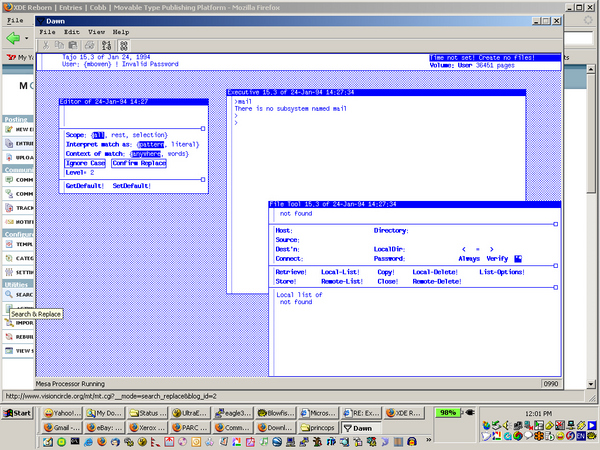
Every year I go through a period of depression thinking about what might have been had Xerox been successful in marketing and selling the networks, operating systems, workstations and printers that they developed. And then thinking about it today, I wonder how little it might have meant considering the death of computing kings like NCR, DEC and Silicon Graphics, not to mention Apollo, Cray, and Symbolics. Still, a small but a mighty big word is 'if'. Then I wake up and realize that there were people there at Xerox who said that there was no future in email - that business people would never trust it and managers would never learn to type.
But while I'm still nostalgic, I'm going to bring up some historical stuff that I recall here and over at Cubegeek (which I've been neglecting). Stay tuned.
January 18, 2006
VPN Based P2P
My latest crazy idea is VPN-based P2P. It looks like Hamachi may be the way to go. There are also some other possibilities.
Hamachi is discussed here too. Leo Laporte is aware of it and has a couple podcasts about it. I'm going to try this for the time being. It's supposed to be very close to the holy grail.
January 04, 2006
Google: Planetary IT
Google as Berkshire Hathaway
What if Google never split its stock? Right now, there are analysts who see it going to 600. Today it's at 442. What does Google care if it never splits the stock? What are the chances that a stock that's up around 1000 falls to 500? Does a stock price influence buying? I think so.
I just had a thought about what Google might do. Maybe Cringely's stuff is just getting through my thick skull. What I imagine is that Google will decide to be the single huge global operating system. The more you compute, the more Google grows. Google is trying to be the best IT system on the planet. It has very strict rules about its APIs and it picks the best ones and publishes them.
Google as planetary IT reminds me of another old idea of mine. Back in 95 or so, when online banking was first getting started, I thought it would be a great idea for banks to become data trustees. This was back in the day when disk drives were all we had, and Iomega was considered the best possibility for backup. FWB had the best drives, outside of Seagate and people were just beginning to take the word 'terabyte' seriously. How it is that I ended up with my own terabyte of data is a long story, but I am increasingly taking advantage of websites like Flickr. But I'll tell you what, as soon as I can save all my MP3s and JPGs up on a Google service, you better bet I will.
That means my Google ID is becoming more and more important to me, even though I don't use Orkut any longer. Which brings me to another point. Yeah it's cool that I have a Pay Pal Card, but what about a Google ID card? To what extent does and will the public trust IT companies to manage things better than banks? If you think about it, banks have, in their own way had their authentication practices upstaged by those of internet and other providers. If you own a domain, for example, there is a much more complicated set of authentications than are required by banks. So will Google get into the identity business? It seems inevitable that they will. So what are the possibilities that certain transactions within a Google account are made as secure as those of say, Pay Pal? Ultimately, for people to trust Google and their Google identity, this must be guaranteed.
I like the idea of a private company with access to the security experts in the field being responsive to such information. Sure some people will get nervous about having 'all that information about me' cross-referenceable. We may never know if Google is hacked by the Feds for this information, but we'll trust Google first.
Google Enterprise
I wonder if and when Google might venture into large scale computing for enterprise applications. You see this is a place that very few corporations have gone. We all know they keep outsourcing their application builders and designers, a trade-off in quality for expediency and cost savings. I believe that Google has learned lessons building general purpose super-scalable applications that no IT departments have yet learned and that the biggest DB software companies like Oracle and Teradata believe only they know. That is the top of commercial computing, and I'm thinking of ways to get there. The ease with which Google is mastering application rollouts is fairly astonishing. It's something nobody else is doing. Their partnerships with Sun and AOL could mean business, and the idea of the Google Box means that all things are possible.
December 08, 2005
Real P2P
I've been so busy with work it has almost made me forget about politics and culture. Thus I've gotten wrapped up in the fun of tech culture. Tech politics are hideously annoying, unlike American politics which is endlessly fascinating and entertaining. So I'm trying to do a couple new things for my home system Christmas Upgrade.
The first is getting serious about P2P. But here's the thing. Almost none of the P2P software I can find out there is real P2P. It's all kind of file swarming software for anonymous people out to get warez, porn and otherwise hijacked & contraband materials. I'm actually looking for something to use with trusted peers who can host and search. What I don't want is a whole lot of anonymous nobodies looking at my shared stuff and downloading at will. What I want is to specifically give access to my mother and my father and my cousin in New York and a half dozen other family members.
So what's the right P2P solution for people who want to share media with known peers only? So far it looks like the Gnutella protocol is the right one because if everybody has a limited node list, then the whole thing stays private. There's only one shortcoming which is that it appears that to do direct connections, everyone has to have a fixed ip address. That can't work. I've got dialup people in my family. I like the LimeWire interface and it looks simple enough for everybody to install and use. But does it use other protocols? It's worth paying for a good commercial client, but I don't want third party servers negotiating all my stuff.
I've heard that Webdav is a nice protocol but that's way too low level for moms. What would be a good front end for that that would let her browse thumbnails of my pictures? I've also considered FileZilla but does that give me search capabilities on MP3 files? It's just FTP, secure and nice, but I don't think so.
What's a good brother to do?
November 22, 2005
Joomla
In my random quest to master various parts of the web, I have discovered Joomla, a startlingly beautiful CMS. So I'm putting together a package for my kid's local Scout troop and seeing if I can make a go of this as a side business.
Joomla is massively configurable, an order of magnitude more sophisticated than Drupal. And yet it is so well designed that although it looks daunting at first, it's fairly simple to use. I have gotten lost a few times in Drupal, especially when putting together custom content types, but Joomla presents no such problems.
That said, they have different approaches and seem suitable for different scales and types of applications. This will be my fifth CMS starting with Userland Radio. Post-Nuke that I used over at Cubegeek was the second I learned. MovableType we all know and love. Drupal is very cool and Joomla makes five. I see Joomla as best suited for an organization that makes formal announcements to a large audience. It's not so much a community-driven portal as Drupal in that it gives a great deal more control over what gets pushed out to the site, in what categories and what format.
Here's a link to the sample site for the Troop in progress. Check it out.
September 28, 2005
Big Iron, Big NT
So you learn something every day.
This week, I'm playing with the biggest hardware I've ever worked on. I've been on an SP-2 before and I've worked on an E-10000. I've even had a fractional Regatta. But the new heavyweight champion in my little world is an HP Superdome with 16 Itaniums. The damned thing is running NT.
But this is no ordinary NT, it's the 64 bit Datacenter Edition, something my many customers have avoided with one notable exception. That was the guys at Waste Management in Houston, who for various reasons were given to continual scoffing.
Today, I'm about to see how monster this baby can go, as I'm heading up a performance benchmark team. Should be interesting, especially if we decide to bump it up to 64 processors. Yow!.
September 26, 2005
Anti-Convergence
I cannot remember who it was that said that we human beings don't like convergence, and that it is something of a common sense matter. I'm thinking about this upon consideration of the following muttered by some dude who works at M$.
While Nintendo advocated a paradigm shift to attract new gamers, Bach and his colleagues also saw a 'revolution' coming, but focused on convergence in the living room. The Microsoft executive's primary position was that "Xbox 360 will be the ultimate digital amplifier for the digital entertainment lifestyle", and the 'hi-def' nature of Xbox 360, much used as a buzzword by J Allard during his 2005 Game Developers Conference talk, was again a major keyword.
Oh. Now I remember. It was the Economist that I bought two weeks ago. Anyway, I've found some interesting things with regard to having purchased a Treo 650 last Christmas. Some things it does very well, and some things it does redundantly. I used to say that the fact that the Treo allows me to go places without my laptop made it worth the 600 I paid for it. Nine months later I have a different set of ideas.
Redundancy is Good
I can play DVDs on my current XBox as well as about half of the computers in my house. My T41 does a pretty good job as well on the road. But my old XBox died and between the time I replaced it I relied on a good old fashioned DVD player with VCR for about 150 bucks. It doesn't make sense for me to spend a premium for all in one functionality. I'd rather have overlap with cheaper components. The XBox can't be hooked into the stereo because I need clunky wiring to send the audio to the TV and the pre-amp. So when I play XBox DVDs, I can't kick in the Infinities. I can live with that. I just use the cheap player which routes into the Tivo and that goes into the preamp. Someday I may buy a switchbox to allow them all to hook into the preamp but that only means I'll be hearing Dead or Alive 3 at 7am on Sunday morning.
On the mobile end of things, it's a little different. As much as I love cargo pants, I do have a limited amount of pocket real estate on an average day. As well, I have to have a reasonable weight limit for carry ons. What do I give to get? By combining a camera, a phone, and an mp3 player as well as a browser and email client, the Treo is next to perfect. However the camera is decidedly low-fi as is the monaural mp3 player. It's practically a tease, although I'd rather have the weakly implemented features than not.
August 10, 2005
EVDO At Last
So me and my new professional colleagues are gelling fairly well. In fact, my reputation as a conservative is making me the butt of some halfway decent humor. T-2, one of the few alpha-geeks who could very easily pass for a generic type-A, has got me as a closet queen who only pretends to oppose gay marriage. I'll be thinking of some clever comebacks soon.
But the ribbing that kills me the most is that one of the sales sharks has actually outdone me on gadgetry. So the other day we're sitting in the bar of the Courtyard bitching about how we have to compete with Microsoft promises, and he's doing email on his laptop. I mention the fact that I can't get any WiFi in this joint, how could he do it? "I've got an aircard", he says. A what? He points to this Verizon PCMCIA sticking out of his T41 and I'm stunned. I knew this was coming, but I thought it was still in beta. Where have I been that I haven't heard about this?
Now one scoop is bad enough, but he fronted on me the other night about SAP's middle tier. Weblogic is going to bite the dust to SAP? It seems impossible to believe. And yet it might be. Well this and EVDO is just too much. I mean I can bear the fact that sales sharks make all the money, but scooping me on gadgets and middle tier?
I did get back at him by making a very cool powerpoint, but it still doesn't seem to make up for it. So I wound up at the Supermall of the Great Northwest's Verizon store. Within 45 minutes I was doing some serious downloads in my car. Sweet. Finally, the promise of Ricochet is real and the coverage is great. Sprint got scooped on this one.
For 90 bucks a month I now am rid of the problem of corporate firewalls. I bring my own laptop and I surf where I please. No more ssh tunnelling to lynx so I can blog during business hours. (Lynx really sucks when it comes to Typekey authentication or other https). I can IM, listen to streaming audio, FTP. Way cool.
As far as I can see, there's only one problem. I don't get to expense it.
April 04, 2005
DTS Bitching
I don't know whether to piss and moan because I have been forced to use DTS or be glad that I'm learning it. Hmm. I guess I'll just bitch. It turns out that DTS has a very clever trick. You see its scheduler only runs the versions of the DTS package that you created it with. Sensible, but counter-intuitive.
So imagine that you inherit a pile of spaghetti in which the production stream is, for some unknown reason, stretched across two machines. So half of the production run goes on one DTS package which then FTPs data over to another SQL Server and which then runs another set of DTS packages. You find a silly glitch in one of the packages, correct it, save it and you're good to go right? No. You have to disable the calling job and recreate a new job.
Of course there's no way to tell this unless logging is enabled. Is it? Hell no. So when I enable logging, I get some godawful hashed names. Well, I shouldn't be so harsh because I like hashed names, but we all know the Microsoft hashed GUIDs don't use a real secure hash. But I'll play Monty Hall and give a big blog shout out for whomever can show me the MS Hash algorithm.
And what's the deal with the internal names in the text logs? What do I care about DTSTask_DataPumpTask_43? Why do you think I put human readable text in the description box, maybe so I could read the log? Duh! I still haven't figured out why parameter passing doesn't work like it should. Something tells me that the scoping rules won't work either. And don't even get me started on notifications and operators.
Why did it take me a week to figure this out? Because there's no test environment of course. We just slam everything into production. Now you know I shave my head, there'd be too much grey.
March 29, 2005
To Kill a Mocking Process
I have just been introduced to something that is giving me a reason, albeit late and a small reason, to respect Win32 just a tiny bit more. It is the Resource Kit.
Now I'm sure there are plenty of you out there who say, boy is this guy on the late freight. On the other hand, UNIX had kill -9, the lung-ripper, generations ago. That's what I needed and found in the Resource Kit. Virgil, if you're out there, you score one more point.
So I am finding a few more POSIX style utilities for Win32 and that's a pretty good thing. But I just wish I could get my old school ksh stuff to work without Cygwin. One of these days, I suppose.
March 10, 2005
Microsoft Buys Groove
Now here's something to be interested and perhaps very skeptical about. One way or another it's a big deal. Ever competitive, MS has just stuck a sword through the gut of Chandler. In the battle for superior office collaboration, Ray Ozzie smashes Mitch Kapor to the carpet. The question is whether or not Groove will survive integration with the next version of Windows.
My prediction is that it will be stunningly complex on the back-end and fabulously friendly on the front. I say this having successfully Grooved for several months last year. Right now, the integration of Groove and Windows is flawless, down to the 200 Registry entries, and the changes to Windows Explorer. In fact, it's rather difficult to get rid of all the tentacles Groove inserts into Windows. Groove is a collaborator's dream in that it obviates the need for File Servers and Briefcases. Everything is synchronized nicely, in near real time.
I have yet to come across an implementation of Windows Active Anything that works very well across an enterprise. Groove has the best chance of anything yet. It is a secure and non-clunky way of enabling collaborative objects.
The best thing about the Groove desktop is the interface. It is good enough for people to be immediately productive. It has taken Ozzie and company several years to accomplish this, and their latest version is truly all that. I've heard somewhat stupendous things about WebDAV, but I'm not holding my breath. What Linux does on the desktop is cool, but this is the killer app.
I predict that Win32 developers will start creating sharable objects for Groove as soon as humanly possible, and that it marks a return to fat-client basics. What is Groove's competition? Web Services. I have a feeling that a lot of .Net developers are going to take it on the chin.
Groove is a big enough and killer enough app to make Windows a much more attractive proposition, and no there isn't a Mac version. I have a feeling that if it gets deep enough into the OS, it's going to be a whole new world. Groove has the capacity, in my estimation, to be for Windows what the combination of Aqua and i-apps are for Mac, with security and collaboration built in.
March 07, 2005
Get Scrobbled
Oh yeah baby. I'm gettin' my 'scrobble on.
OK it's true. I slept on this one even while knowing better, but now I have seen the light. Audioscrobbler is the coolest thing on the internet since Orkut. I predict that it will get eaten by Google in due time, which brings up interesting questions about Google's appetites and the amount of goodwill it has yet to squander.
If you haven't heard, Audioscrobbler is the Soundscan of P2P. Just drop a plugin to your music player and it sends the ID3 data from your music files to a collection service. Under your 'scrobbler account will reside a plethora of realtime stats indicating your musical predilections, assuming they are reflected in your actual listening habits. There are, presumeably, some privacy protections in aggregations and the gamut of Orkutrificated affiliative goodies which makes for some interesting rotisserie possibilities.
They've opened up the middleware and data via Creative Commons, a brilliant move that may yet deter omnivorous corporate-types, (and delay the gawdawful task of data cleansing) inviting data warehousing hacks like myself to have a field day. So there are multiple ways to have fun in this playground.
If you get 'scrobbled, look me up and friend up. Cobb of course.
February 20, 2005
Ekranoplanes

The kids are soaking an unusual amount of Japanimation today. I notice that one called DICE featured a futuristic flying boat. Hey, wait a minute, I've seen that before. It's an ekranoplane. I'd love to see one of these badboys built, get the coast guard a couple dozen good sized ekranos and we'd radically tilt the balance of power on the seas in the WOT.
Check out the whole story.
The important quality of speed was, in all times, the object of the steadfast attention of ship-builders. But the increase of speed for ships was limited by quickly growing hydrodynamic resistance in the case of an insufficient capacity sail and oar movement.This restriction was removed with the introduction on ships of mechanical engines in the middle or the end of the superstructure, but the situation did not change , even for ships at the beginning of the Nineteenth century. But speed could only go so far in any case, and even nuclear powered ships of the Twentieth century concede little to steamships. The trick in speed was connected to idea to lift the keel of a vessel from water to air, an environment 840 times less dense. The main obstacle, growth of resistance of water, disappeared.
November 17, 2004
Missile Defense News
My buddy tells me that the DOD has put together a successful test of the Airborne Laser. Say what? 6 powerful lasers that paint a blistering hot softball-sized spot of pure energy at a ballistic missile in boost phase? Holy smokes!
But wait. Here comes the skeptic in me. I remember when the stealth technology first came out. Some of my engineer friends made me get that same yahoo feeling I had this morning, but as we sat and talked about it, as engineers do, he suggested a flaw. In Feynman like style he asked, OK so if our stealth planes are invisible to radar, how do we know where they are? He said, radar waves aren't the only types of energy in the electromagnetic spectrum. And so with that I inferred that we use microwave radar which he neither confirmed nor denied. I haven't followed up, because I have come to understand that new weapons systems are simply designed to leapfrog.
So how does the offense win in the ballistic missiles vs lasers war? Taking the same line of questioning, how do we avoid getting burned by our own lasers? Why smoke and mirrors of course. Hmm. Watch for new export restrictions on that kind of coating that turns regular sunglasses into mirrorshades, and pray for sunny weather. Other than that, suck on this Kim Jong Il!
October 31, 2004
Digital Me, Video Mods
It has been a while since I first created a digital self with the character creator in Tony Hawk Underground. Since then, I've been to Second Life and There to create online avatars. I've also built several for regular games including Morrowind, KOTOR and others. So far, it has been the Tony Hawk engine that has done the most accurate me.
I believe that this kind of thing could be standardized and that we should all have a library of digital avatars to represent us in different games. You could have a superhero you, an avarage you, an evil you, a sexy you, etc, all stored in your home digital library. You could have a skin and skeleton studio and build up multiple copies and save to a number of formats appopriate to the games you play until such time that there was one universal standard - like True Type fonts. Clearly the technology for avatar creation is in place. What's not is the home version, nor the cross platform standards.
What struck me the other day was this could be the entertainment that replaces a number of lower tech implementations. The spark for this was the MTV2 show 'Video Mods'. It's nice and primative at the moment - but I can see a commodity ready for desktop in a couple years. The concept? Amateur motion capture.
There are a number of ways this can be done. The simplest might be something along the lines of a pseudo-dynamic cel shading effect done with a filter of a digital video taken with a consumer DV camera. Think of the characters in the film 'Waking Life'. Another method might be to grab several seconds of cheaply done motion capture and insert your avatar into your favorite music video. But there are a lot of interesting kinds of things that might emerge from this direction.
October 18, 2004
Call for Assistance
I'm throwing my hands in the air and waving them like I just don't care. I cannot get this idiotic version of MT to do what I want it to do, and I would appreciate (as well as pay) anyone who could align my templates and make these god forsaken comments work. I am going bonkers approving each and every comment, and now that MT-Blacklist doesn't work with the version, the spam is driving my nuts.
Just email me if you know your way through this thicket (or try to get a comment posted).
October 12, 2004
The Buzz on Abuzz
Abuzz was one of the most innovative and useful websites I've ever used. It had everything necessary to generate interesting semi-expert information on every subject imaginable. I've been thinking about ways to incorporate such tech into a new site, and I found that it went belly up, sorta. It's hard to know how many users it was supporting and how much money they burned through, but it was very reliable and had some damned good stuff.
I'll be looking around for fragments of that code & staff. About.com is a little too commercial.
October 11, 2004
The Thumbchip Dream
I've had the same bad dream for almost 15 years now. I'm stepping off a Lear Jet, somewhere in the future, and the scanner in the doorway erases the chip in my thumb. I suddenly realize that everything I've ever created, other than my children, is contained on that chip and I didn't have a backup. Yike.
I've dismissed the dream many times, primarily because it is my experience that a great number of gigabytes of data I have already lost over the years mean very little to me. Even when the thing lost has been a favorite cassette recording of Jeff Beck, I've been able to recover it in a different way. Other things were only sort of valuable because of their format. I backed up a PC onto an Overland Data tape drive over a IBM data channel. That was cool back in 1987, but nothing then, including the font I designed myself using some old Xerox tools, is useful now for anything but nostalgia. What I continue to miss are the medals, ribbons and trophies I won in high school, and pictures of me when I had a jheri curl. Nevertheless, I do have a continual problem taking my data with me which continues to give the dream longevity.
Two summers ago, I purchased a 40GB external USB drive from Maxtor for about 300 bucks. It allowed me, for the first time, to retrieve Eudora mail when I was on the road and then use that same set of files when I got home. In those pre-GMail days, I never had much use for webmail precisely because of my inability to depend on it for long periods. Today, whether or not it's security wise, I route all of my mail through GMail as well as download it through Eudora to my hard drive. So I don't have to take my USB drive on the road. The other thing I was able to do with the external drive was keep my very large set of customer data, and trickbag. So I have about 2GB of files that I could reuse. I also have a goodly set of music on the USB drive. All that kept me happy when my laptop only had 8GB of disk, but there were always problems with synch, not to mention headache inducing problems between Palm and Outlook.
I've been sitting out the past few years on new hardware and portable devices precisely because of these problems. In the meantime I've been making a lot of use of FTP and my DVD burner. It's nice to have a couple GB of mp3s easily playable through my laptop and Winamp contained on a couple of burned DVDs, but I still wish there were a better solution overall. I almost bought Groove, but I was never able to get it to synch on demand, and I simply don't think it's worth $250 per seat. But I have been very happy with my USB key with 256MB. I keep all of my passwords and valuable volatile files there. It solves a number of problems, but not quite enough.
The other day I saw a woman pay for her lunch with money she took out of her iPod wallet. Cool. Wouldn't it be great if the iPod could be used for more than just music? I've also been following Oqo, hoping they get their stuff on the street, and of course I'm struggling with the pathetic internet access of my Sprint PCS phone (two years old) and my black & white Palm Vx. Still nothing quite does it for me, not a Treo 600, nor any of the other PDAs.
Just yesterday, the wife found a 7 year old removeable hard drive from an old Compaq laptop. 2GB, pocket sized. Wouldn't it be nice if... Hmmm. Now I've also heard rumors that the XBox 2 is not going to have a hard drive. You'd buy an iPod-like device for your game storage and probably everything else storage. But what's cooler still is this long post by Mark Cuban including this delicious bite:
I had a couple DVDs that I had PURCHASED, that I hadn’t had the chance to watch. I had a couple 512mb Flash Drives that I had bought specifically to test them out for video. I took the first movie, and using an encoder with compression (not going to tell you which one, don’t want to play favorites), I encoded the movies at DVD quality and saved the output onto each of the 512mb Flash Drives. I popped those tiny little puppies into my pockets and off I went to the plane. Keys, some money and my keychain flash drives in one pocket, phone in the other. No hassle, no fuss no muss.On the plane, I popped the first keychain drive into the USB Port. Got the ready signal, got prompted to open my video player, and watched a nice movie right from the keychain drive. On the way home, did the same thing with the other movie. I loved it. Far less space than DVDs. Could put them in my pocket instead of filling up my briefcase. I immediately went out and bought a 1gb keychain drive so I could hold 2 movies on 1 drive, in addition to my first 2 drives.
So there could be a lot of convergence around the thing that we all want, which is massive portable read/write storage. It's clearer and clearer that DVD is not the way to go and that USB or Firewire based disk storage is. The trick is synching, but what incentive does MS have to make anything faster or smarter than those idiotic briefcases, or refrain from DRM shackles? Hard to say.
I want to add that wireless broadband is just a year or two away, but it won't solve the bigger problem which Cuban sees. It's got to be disk. So I'm going to learn CVS and see what happens if a generic iPod comes out.
October 03, 2004
Expensive Hats
I just read that Ret Hat just acquired some $23 million worth of security parts for their enterpirse operating system. Not long ago I seem to recall being told that Fedora is the way to go for the most serious applications. Now correct me if I'm wrong but isn't Fedora not free software? A cursory look at the Red Hat site, and of their comments to spite Sun Microsystems shows me that Red Hat is a bit less Linuxy than other Linuxes, in that almost nothing is free about it.
Sure there are other distros out there, but I think this is a significant departure from the philosophy of open-source & free software. I don't have a problem with that and in fact I predicted that it would happen or Linux would fail. This is a different licensing scheme, ie different business model. But Red Hat is no longer free software.
September 28, 2004
The Home Network
I'm about to build out a few more pieces of my home network and I'd like to discuss it here generally with folks. Software, hardware, networks. What do you have? What do you like? What's next for your setup?
For me, I've always wanted to build an entire batcave at my place. I just finished installing two new P3-800 Dells that I got used for 145 bucks a pop. They're running wireless (G) off a WAP secured Linksys router which is inside a wired router which is inside Adelphia cable modem.
I'm running an XBox and 2 other servers, both Win2k Server. Plus my pride and joy, a black 3Ghz Shuttle running XP Pro SP2 with no problems. My laptop is on life support but I was just about to replace it with a new Think Pad T42.
Next I want to get a nice Linux box or two. I'm likely to get another cheap Dell P3, or upgrade one of my Win2K boxes to a two way Dell Precision and use that. I've played around with Red Hat most of the time, but now there's this new Fedora thing. I've got a set of Mandrake disks lying around - I got them with the Shuttle. What's Gentoo? I've got an image of the free Solaris as well.
My Linux box is strictly for hobby and fun - to have all the fun tools and whatnot. When I need a real one, for a development environment, I'll know which brand to get. I have yet to be impressed with any Linux desktop, but I'll tell you what. If there's one that can use a Radeon board and play DVDs in the background with translucent windows on top, I'll definitely consider that. Something with customizeable themes that I could run a couple different monitors on - that would be for me.
Also, is there any reason in the world for me to play with OSX or is this strictly a Mac fetish?
August 31, 2004
The New iMac
If I were Bob Adams, I would be punching holes in the walls right about now. Bob Adams, the semi-legend who had the responsibility for Xerox' workstation business must have constant nightmares haunted by Steve Jobs. Today at Apple.com, the new iMac can be eyeballed. The future of computing is now.
Back in 87, when I was at Xerox, the fourth floor of Xerox Centre housed the Industrial Design Group. It was there that I met John Seeley Brown while he was on a field trip. That was the year that he gave his famous 'information as basketball' metaphor. I loved to come down and browse the latest mockups of the computer of the future with their sleek lines and technically impossible flat full color screens. As soon as I saw the new iMac I was transported back to that design center.
Hmm. Now I have reasons to punch holes in the wall. I just learned that Tony Domit actually made a pile himself. Just as I was about to jump ship from Xerox, I spoke extensively with Tony Domit about a new venture which was going to put the Xerox workstation on a PS/2 board. I was only an apps programmer, but had done some fairly interesting stuff on that platform and I was very interested it its future. I most certainly would have had a nice equity position in AWP. He was having a collossal fight with other Xerox managers about getting the product out, primarily because it would make them look stupid. In the end he did. I'm happy for him, and kinda mad about my impatience. Oh well. There's always more money and more business.
August 23, 2004
Gateway + MicroCenter
Gateway is finally showing evidence of brains. They are going to sell their machines in a new deal with MicroCenter. MicroCenter is by far the best retailer of software and software related books in the country. They are most definitely a destination. Gateway has been making mediocre consumer PCs for a long time and completely missed the mark with their cow-flavored retail chain.
I don't know how it can happen, but I am hopeful that this can result in more MicroCenter stores. I may still end up going to Fry's for the prices, but I do miss MicroCenter - which is a much smarter store with far better people. Come to LA, please.
August 11, 2004
VB, VBA, VBS, VB.Net
I thought that I would be able to get away with buying just one O'Reilly book on VB. It turns out that there are even more flavors of this stuff than I thought. Fortunately, the kind I needed was more of the same: VBA.
I shouldn't complain that at this late stage in my career that I am automating spreadsheets. After all, the pay is very good at the moment and it does keep me on my toes. But in the course of doing so I have discovered VBS, which looks to be something I actually didn't expect to find - a fairly capable scripting language for Wintel. I don't know snap about VBS except that it looks like it instantiates methods out of the big class of VB objects. That's a fairly fabulous capability to have driven from the command line. That is, if it all works.
set shell = wscript.createobject("wscript.shell")
set fs = createobject("scripting.filesystemobject")
Since my new business model is taking me on a tour of the Second World, which on days like yesterday appears more and more fascinating, I expect to be seeing a lot more of this kind of code. But it only makes me wonder even more about the 'alternatives' of Perl and PHP. How is it that small companies have overlooked the simplicity of these free alternatives to Microsoft VB? Is real programming talent that scarce? Scary.
May 28, 2004
Telco Subversion
Cringely has a great idea that numbs the brain. Unfortunately it's one of those things that only works at the dorms of tech schools and certain areas just south of San Francisco.
It's based on the latest incarnation of the geeks old proverb, 'If you build it, they will come." Since half the computing on the planet could now be open source, this has morphed to 'If you configure it, they will pay.' Not bloody likely.
What Cringely and boing boingers tend to forget is that most people are lazy. We don't have the time nor the patience to figure out half of these technologies:
If you have a WRT54G, here's what you can use it for after less than an hour's work. You get all the original Linksys functions plus SSH, Wonder Shaper, L7 regexp iptables filtering, frottle, parprouted, the latest Busybox utilities, several custom modifications to DHCP and dnsmasq, a PPTP server, static DHCP address mapping, OSPF routing, external logging, as well as support for client, ad hoc, AP, and WDS wireless modes.
Then he must certainly add:
If that last paragraph meant nothing at all to you, look at it this way: the WRT54G with Sveasoft firmware is all you need to become your cul de sac's wireless ISP. Going further, if a bunch of your friends in town had similarly configured WRT54Gs, they could seamlessly work together and put out of business your local telephone company.
This sounds remarkably like: "Look at it this way: an ordinary PC with Kazaa or Morpheous software is all you need to become your cul de sac's digital jukebox. Going furhter, if a a bunch of your friends in town had similarly configured PCs, they could seamlessly work together and put out of business your local record store."
Putting people out of business is not so simple as geeks would like to belief. It sounds perverse, but the techno-troglodytes of the world with their inferior expensive technologies fight back, with lawyers. They're not always wrong for doing so.
Of course I like the concept, and it's a cool way to say on your phone bill. But the millions are not going start configuring routers. As soon as they do, Kazaa! There's a can of worms in them thar hills.
May 20, 2004
New Portable Devices
Over at the NYT there is an interesting piece covering the emergence of the Freenhand Systems amenuensis. As soon as I saw the device it reminded me of the RocketBook.
I remember that the RocketBook was a good idea, priced entirely too high. I wonder if it could make a comeback.
This device only costs 1200 bucks, which is the cost of a good laptop. But for musicians the benefit is readily apparent.
Kurt Bester, 48, a pianist and composer who also tested the device, said it had freed him from fumbling with paper when he plays since he can turn the page by tapping the screen or pressing a foot pedal. The bright screen helps him read music in dark rooms, take notes and even archive music he writes before it has been printed."This is my sheet-music iPod," he said.
I'm sure the thing has a foot pedal so that you can turn the page without having to let your fingers leave your instrument, which by itself is well worth it. But what's fascinating about Freehand's innovation is the price point.
Remember that Tivos now cost about 200 bucks. Considering how much has been crammed onto the Microsoft and Apple platforms, not to mention game consoles, PDA and cell phones, there must be a wide variety of special purpose devices that professionals could use much better than a PC.
I think this could be an important development.
April 27, 2004
VPN Headaches
Well now I've swallowed a firehose. I'm signed up to work on three projects at once. It's nice to have a full plate for the first time in many months. I'm getting into the groove of working at home.
Anyway, I'm getting headaches trying to get my VPN router to work with XP. It's a real pain, and I'm trying to do anything I can not to have to purchase one for the other end, but it's starting to look futile. I've got the Linksys BEFVP41 v2 and it just is pure annoyance.
How is your VPN setup?
April 06, 2004
MTC
It's a pleasure to try out this new toy I have. It's going to allow me to correct my spelling mistakes and do a lot of other cool things. It's called the MTC or MT client tool. Big props to Prometheus 6 for building this doohickey.
March 16, 2004
February 04, 2004
January 22, 2004
Bone Phones
 Bone conduction is back!
Way back in the 70s (literally) I used to sell stereo. One of the new gadgets that came out right at the same time as the Walkman, was the 'Bone Fone'. It was a radio embedded in a 24 inch long tube of flexible blue spandex. You wore it over your shoulders like an athlete wears a towel around his neck, or somebody named Biff wears a wool pullover when the sun comes out. The heavy parts were in the ends so you could actually jog with it on.
It used bone conduction to transmit the sounds through your collarbones. Or so it promised. They went for 65 bucks and I sold maybe 3 of them in a whole year. They really weren't very powerful and it turns out that collarbones don't resonate bass very well. Good idea though.
Well apparently, some folks in Japan think that speech is another matter, so they've gone ahead and made a bone conduction cellphone. It looks ridiculous, but it just might work.
January 16, 2004
Hard Mustang, Soft Mustang

Above is the Ford Mustang I expected this year. Below is what we got. Ho hum. I cannot believe how tame the production model looks compared to what it might have been. And you want to know the worse thing about it? From the front, it kind of looks like a Camaro.
They clearly stayed away from the higher profile square look which was the most attractive thing about it. Instead they made it more wedgey. The wheels look smaller and overall it's a much more rounded version. The first thing that hit me was the rear quarter window. It almost looks like a bubble compared to the flat windowless version above. The rear view is even more disappointing.
The good news is that the interior is really great. The engine looks pretty hot, but I may have been looking at a special version of the production car. It's a marked improvement over what's out there, but it might have been fabulous. Now it's merely very good.

January 14, 2004
C#: A Reason to Love or Hate?
My boy V and I are having a monsterous debate about the virtues and villainy of Microsoft. We're both too small to see the whole picture, so it's tough going.
On the one hand, we are both unanimous about Microsoft's coming leadership in the game console market. They deserve it. XBox rules for many reasons, not the least of which is what an incredible thing they've done with contracting out the hardware manufacturing to Flextronics and now chip manufacture to IBM.
We clash over the issue of Java and somewhat don't care since we're talking past each other over which part of web services is more important. To me, it's unquestionably the back-end. V is a user interface guy and all for fat clients.
So I'll open the next salvo with the fate of C#. Understand that I don't want to be the one to foolishly bet against Microsoft. But I've got to say this. If Microsoft wasn't deviously trying to destroy Sun out of spite, they never would have created .Net nor supported the development of C#. I want to be a C# developer for fun and profit but I have a very sneaky suspicion that Microsoft is going to make me pay dearly for that.
As I said this summer, I've heard very good things about .Net from people I trust, but where is Microsoft positioning products to compete against BEA's Weblogic and IBM's Websphere application servers? This is the big question. Again, I am suspicious that MS is going to make me pay for something that isn't an open API.
To be continued.
January 07, 2004
Because It's Worth It
I just discovered a very cool piece of software called Alcohol 120%. It sells for 50 bucks and appears to be able to master just about every laser disk scheme and recording format on the planet. That includes CD CD-R, CD-RW DVD, etc etc. It's an impressive work. It got me thinking about the ability to show movies on my new flat panel monitor from the DVD drive on my laptop. I haven't done this in years.
But it also got me thinking that I might finally be able to burn a CD that my XBOX would recognize as a redbook CD so that I could put some of my MP3s over onto it. I have never been able to take my own burned CDs and rip them onto the XBox's WMA so that I could use them as the soundtrack for games. It's also fairly annoying to me that the XBox, while it reads commercial CDs, doesn't use Gracenote and so I have to enter the names of the songs with my controller. That's a nightmare. At any rate, there's a good chance that I'm going to get this sucker. The best reason is because it manages CD images.
If you have growing kids and disposable income, chances are that you have a bunch of old Broderbund or Knowledge Adventure CD-ROM games around the house. We have at least 40. The old ones are all scratched up and about ready to go kaput, and that's not only because they use QuickTime version 2. It's because kids handle them. Over the years that costs a lot of money and I don't want to throw away these CDs, especially because I have a burner. But I've never been able to make copies of these CDs that work. Alcohol promises to solve all that, and I've seen enough software marketing to know when people know what they're talking about. It's the standard here at the test lab which employs me for the moment so I trust I'm not in for any surprises.
Thinking about the possibilities, I wondered if I might do the same with my XBox games, which are generally more costly than the PC games. There doesn't seem to be anywhere, at a casual glance, that I can find anything on the subject. However I did find out that a certain site called ISONews talked a little too freely about this subject. Well, the speech was free, but the mod chips to defeat certain security elements of the XBox scheme were on sale. The US took over the site and tossed its owner into the clink. I read through the story about this which was presented with some alarm from civil libertarian front. But this time, unlike with the RIAA, I didn't find this character's plight particularly sympathetic.
I've been one to download everything all the time. I'm a shareware, freeware, whatever warez mack daddy. If it solves a problem, I want it. Nothing has slowed me down but the RIAA lawsuits, and I have changed my behavior accordingly. But the reason I don't feel particularly drawn to the case of the ISONews pirates is because I think XBox games are generally worth the 50 bucks you pay for them. Whereas I think DVDs and music CDs are generally not worth what they go for in the 'marketplace'. I think Wal-Mart's price of 88 cents per downloadable single is good although I'm not comfortable with non-MP3 formats just yet.
I don't want anything encrypted that I don't encrypt myself. An appliance & bulletproof system, I could live with. If I were strictly Apple, for example, I probably wouldn't care about using proprietary encrypted music so long as the integration is seamless and completely portable with the iPod/iTunes thing seems to be.
This is also the case for XBox. I see unique value, there's nothing it does that I want done anyplace else, and I get real value for my dollars spent. So much so that I have alternate ways of feeding it proprietary encrypted games. I don't feel the need to work around the system, because I agree with the price. In fact, I am so untroubled by this matter, that I am considering buying a second totally incompatible system, the Gamecube.
The democratization of production and distribution tools for music has changed the value of it. The marketing of it has not changed nor has the pricing. This, and the failure of music companies to understand and respect the nature of the computer business has put their business practices into the realm of public debate. But it is most fundamentally a problem of pricing. Wal-Mart will prove it.
December 31, 2003
Compression
Today I found a great compression utility called 7-Zip. It's tiny. The installation executable is only 920KB. It supports a wide number of compression schemes including RAR (which is my current utility of choice - the one I licensed and paid for.) and BZIP2.
What the heck is .bz2? I've never heard of it, but apparently it's a butt-kicking format that does up to 40% better than .gz. This is news to me. According to Breton Chapin:
In general, Burrows-Wheeler isn't as fast as LZ variants.
Theoretically, it takes O(n) time to sort the input. This assumes
that strings of any length can be compared instantly. Practical
algorithms for sorting for BWT actually take n log n, or n*a, or n log
a where a is the length of the longest match, because arbitrarily long
strings cannot be compared in O(1) time. Memory requirements of these
algorithms vary considerably, but all are many times the size of the
block, whereas LZ variants get by with a relatively small fixed amount
of memory. bzip2 uses 2 algorithms. bzip2 starts with an n*a which
works great if the data is not too repetitive as then a will be small.
If it's taking too long to sort the data, bzip2 switches to an n *
log n algorithm. gzip uses an O(n) algorithm that really does run in
O(n). If you were compressing 50M in one big block (bzip2's max is
900K blocks) with an n log n algorithm, you could expect it to take
around 25 to 26 (log base 2 of 50M) times as long as an n time
algorithm.Then there are implementation details. Because BWT uses so much more
memory than LZ, performance of a system's memory (caching, especially)
becomes an issue, for both compression and decompression. Also, bzip2
makes its comparisons one byte at a time, rather than one 32 (or 64
bit) word at a time. (Don't know what gzip does there.) I modified
bzip2 to do comparisons 4 bytes at a time (on little endian machines)
and got about 10% to 15% improvement in speed of compression.If you think bzip2 is slow, try some of the older PPM implementations
from before people realized PPM could be as fast as BWT. On the other
end, the old Unix "compress" is faster than gzip, and back in the 80's
people sometimes complained about gzip's "slowness", asking if gzip's
better compression was worth it.
Wow. It's been so long since I've heard a real computer scientist speak. You learn something new every day.
December 21, 2003
So Where's the Product?
Very huge exciting news in the world of speech recognition occured several years ago when two USC professors found a solution that would be able to discern human speech from all other kinds of noise. They claimed to have solved the problem which had made all previous SR products impractical - you can't use them in noisy environments, like driving your car or walking in an airport.
So where's the product? I haven't heard anything. Have you?
December 17, 2003
Rutan's Rocket
 On the 100th anniversary of the Wright Brothers' first powered flight, Dick Rutan's SS1 has gone supersonic. Big ups to the crew!
USA Today has some verbiage:
"Our flight this morning by SpaceShipOne demonstrated that supersonic flight is now the domain of a small company doing privately funded research, without government help," the company said in a statement. "The flight also represents an important milestone in our efforts to demonstrate that truly low-cost space access is feasible."
Rutan has been in the independent aircraft design business as long as anyone can remember. He replicates the determination of the Wrights who ran hundreds of glider flights before their first powered flight.
There have been several announcements this week. Boeing is making a new midsized passenger jet, the 7E7. It doesn't sound particularly spectacular, unlike Airbus' new A380 which is a massive super jumbo which outclasses the biggest 747s by a bunch.
Powered flight has come a very long way in 100 years, and I don't doubt that unmanned fighter jets are just around the corner. What a world. What a world.
November 18, 2003
MS Mainframe
Last night, my new pal Steve from Richmond was telling me why XML rocks and .NET will dominate. I don't believe him, but I cannot ignore his enthusiasm. In fact, enthusiasm is all I hear about .NET and despite the fact that a lot of this comes from prior VB programmers, at least one Java wizard I know has been sold as well.
I keep holding out for UNIX dominance and have over the years. But I should know better. NT works on four way boxes with screamingly fast processors. That's more than enough to build some gnarly systems. But as Cringely suggests, there may be a trick up MS' sleeve to raise that headroom even higher.
Remember, IL ultimately makes .NET and Windows hardware independent, decreasing Microsoft's dependence on Intel and increasing its power over Intel -- the power to give and to take away. There are instances where Microsoft might want to move away from Intel. Redmond has not done a very good job of putting its software on large-scale servers, for example, largely because its hardware partner doesn't scale well. We're seeing Intel-based servers now with up to eight CPUs, but that's about it: Above eight the increased overhead means it isn't worthwhile, so we do clustering, instead. But now Microsoft is flirting with IBM precisely because IBM's Power architecture scales beautifully. If Microsoft wants to grab one of the last pools of profit it doesn't currently own -- high end corporate computing -- putting .NET on IBM's Power and PowerPC are a key.
All the promise of Beowulf is real and Linux gurus have clustered cheap CPUs to build massively parallel machines. There is probably no better example of this than Google. We know MS tried to buy Google. What better way to show off their ability to handle any compute problem than to put Google on the new MS architecture? Having failed that, MS goes to IBM. Genius. See?
October 28, 2003
DRM Eats Its Young
Like Rafe Colburn, I like iTunes but I'm not likely to buy any DRM protected music from the Apple Music Store. Why? Because as an old head in the software industry, I know how often formats change and how easy it is to lose passwords.
I've gone through about 4 different PGP ids and at least that many versions of the software. I don't use it any longer because I don't have anything worth encrypting that I can't do with ssh to my trusted friends' machines, and two because I forgot how.
Let's think about what we know about human error. In my iTunes Advanced pulldown menu there's an option that says 'Deauthorize Computer'. If there was ever a red cape to bull hackers that's it. But it's also an idiot magnet too. If it does what I think it does (and how would I know, I'm not going to try it), it would disable your computer from using the DRM protected music you've already downloaded and paid for.
Imagine what customer service is going to be like when somebody loses their music. Hello, Apple Music Store? My song doesn't play any more. It gives me this error, "Illegal Attempt Made To Play Music", but I just installed it.
October 27, 2003
Better Random
I've decided that I'm going to stick with iTunes for the time being. I've been trying it for a few days and it has one major advantage over Winamp2, and that is its random music playing. According to iTunes, I've got about 21 days worth of MP3s on my machine - that's about 6500 songs, some of which are duplicates. But there are a whole lot of them I just haven't heard - playing as I do with Winamp I felt as though I were hearing the same tunes over and over but I couldn't prove it. The difference is night and day, plus now I can prove it.
iTunes is a pig to be sure and when I installed it on my C: drive somehow it sucked up over 4GB of disk. I still don't know how that happened or what was going on, but it was headed for the dustbin. I installed it on a remote drive with no ill effects. Still, it hogs a lot more memory than Winamp and when the tasking gets tough, iTunes flubs up big time. Fzample, ripping and playing are a bit much for iTunes in 356MB of Win2kPro. That's piggy.
A big advantage it has is the ability to correct multiple tags at once. I can finally get rid of all the bogus genres. It also adjusts to play songs recorded at different volumes at a consistent volume. This is incredibly useful for me because I put some soft classical on at night before bed and then I'm suddenly jarred awake by a loud cut, or I can't hear anything after the first song.
I'll keep Winamp for my DJ duties because iTunes doesn't fade nicely when I'm manually cueing up tunes, plus the CDDB doesn't work at all with iTunes even though the ripper is decent.
October 09, 2003
Bass Station
This is a very cool idea.
The Bass-Station is a mobile, visually loud, and funky 1980s Boom Box. Imbedded within its shell is a modern computer and wireless networking components. By creating a locally accessible wireless network, people of an intimate community can use the Bass- Station as a hub through which they can freely and democratically exchange information. By actively observing the exchanges of a small community, you can learn things about that community that you couldn't by talking to any one of its members. The Bass-Station is also a shared stereo that makes its presence fun and entertaining.
Sony should be all over this, and I mean like yesterday. I want one.
September 27, 2003
OICW
I don't know if Heckler & Koch is an American company. Well, of course there is a US corporation but the company originated in the ruins of the Mauser works in post WW2 Germany. They have apparently dominated the imagination of the US Military with their newest rifle, a sophisticated affair called the OICW.
OICW stands for Objective Individual Combat Weapon, and has gotten the designation M29. It's a rather massive thing for a machine gun and is chockablock with goodies like timed explosive rounds. If your enemy is behind a wall, you can use the rangefinder and program a bullet shot just over the wall to rain down deadly shards at the precise moment. The theory is that this capability will shorten standoffs against the enemy in 'dug-in' positions, not to mention save ammo.
This gun is going to cost about 15,000 apiece and weigh about three times as much as the standard M16, but such considerations mean nothing in videogame simulations. This is how I came to recognize the OICW. The Ghost Recon Island Thunder online game for the XBox allows you to select this weapon for your three member platoons as you carry out missions in a post-Castro Cuba. In gaming this is a great weapon, and your avatar doesn't seem to run any slower with it.
The Germans have come back in their characteristically precise way in helping us to understand the technical specifications of the OICW and other arms as represented in the Ubisoft game. At RainbowSix.org one can check out the Detallierte Waffenlisten.
RPGs seem to be doing a great deal of damage these days in Iraq. The deployment of the M29 may herald a new era in which every rifleman will have equivalent firepower on the go. H&K will definitely play a significant role in the future of urban warfare. With any luck, this expensive, heavy and deadly weapon will not be just a videogame fantasy.
September 19, 2003
Fabulous Power
The t-Zero by AC Propulsion is the first electric vehicle to beat a Porsche 911 in the quarter mile. It runs on laptop batteries.
In this short video produced by the Babilonia-Wilner Foundation, David Wilner, who is first in line for a production tzero, pits his all-wheel drive Porsche Carrera 4 against the tzero in a drag race in the pouring rain at Calstart's Alameda test track.AC Propulsion's traction control system effectively eliminates wheelspin and loss of traction while braking - even when suddenly transitioning between full accleration and full regenerative braking at 90 mph on a rain-slick runway
August 29, 2003
Visual Basic & .NET
Well, I'll say that my humiliation is just about complete. I'm going to take this job as soon as they offer it to me, but it is now abundantly clear that although I am hired as an architect, I will spend a significant percentage of my time babysitting an application built on Visual Basic, MS Access and Excel. That will be OK for a year, I suppose.
But the upshot of this is that now I have to take this kind of crap seriously. I'll be getting my OReilly book on VB and .NET and all that rot so I can work this puppy, but I must say that my enthusiasm is less than stellar. The only good thing is that I will get to play with the API to my favorite database with some depth.
Now J tells me that .NET is not bad at all, and that with the full Visual Studio license kit and all that, that it may be pleasurable to work with. That may be something to look forward to, sorta. But I still want to work with the Linux security guys. You can imagine the looks on their faces..
What is completely on the plus side is that the subject matter for this application is top notch. It's something most everybody has some conception of and is absolutely critical to the company I'll be working at: Film Revenues.
Just yesterday I spoke on the phone to the partner of the one of three folks I respect who are Microsoft Heads. All of them have written books on their subjects, one of which I own. So along with J, I'm not in such bad company. Still, this is going to suck on my resume.
August 24, 2003
False Dichotomy
If, when you think of genes, you think of molecular martinets who bark orders but take none, you have the wrong idea. Genes do turn on and off in response to experience. Ridley also works hard to dispel the myth that environmental effects are reversible while genetic ones are not. In many cases the opposite is true.
A new book out stands a chance of revolutionizing our ideas about nature vs nurture. Unfortunately, a lot of good jokes will be rendered meaningless, but we will be able to poke fun at those mired in the old memes.
Like the author of the review, I am sick to death about those flamewars that pass for ethical arguments about genetics and IQ. I am furhter releived that the waters have been officially muddied by progress in genetic research. Many of my anti-racist adversaries doubtlessly will find themselves disappointingly short of the ammunition they believed was coming from the Human Genome Project's conclusions.
From my perspective, I have always elided the argument because of those declarations of equality stated as principles of the Constitution, but it will be interesting to see how I and others modify our arguments given this new knowledge that genes respond to the environment.
August 22, 2003
SCO Smokes Crack
According to Linus Torvalds, SCO has problems with telling the truth. Not only that, they're boasting about code they don't even own.
Major vendors are kicking SCO to the curb. The publisher of the Linux Journal, Phil Hughes is daring SCO to sue them. The bell is tolling.
The code SCO showed represents an algorithm that can be used to manage a computer's memory...Not a very interesting piece of code in itself, this is very basic "allocate a smaller chunk of memory out of a list of bigger chunks." The function is described in a lot of places, and exists in original Unix code and is apparently written by Ken Thompson himself. It shows up in the Lion book (a commentary on the traditional Unix), and the code is described in [Maurice J.] Bach's "The Design of the Unix Operating System." In other words, it's not only 30 years old; it's actually been documented several times. It's also part of BSD Unix, which was shown to not be a derived work of the AT&T copyrights 10 years ago.It's part of the "original Unix" archives that Dennis Ritchie has made available, and from a legal perspective (and also of ironic interest), it's also part of all the code that Caldera made freely available back when they still remembered that they were a Linux company and had made all their money on the Linux IPO. Ironically, the piece of code that [SCO demonstrated this week] had already been removed in [the Linux kernel] 2.6.x—and not because of copyright issues, but because developers complained about how "ugly" it was. So not only is the code available under the BSD copyright, it had been removed in new versions of Linux even before SCO made it public.
But what I find interesting is how it shows that the SCO people are having such a hard time with the truth. They've said several times that the code they have found is not "historic Unix" code and "not BSD" code (which they know you can't infringe, since BSD has been shown to be independent, and Caldera itself released the historic code in 2002). To counter the open-source peoples' contention that any shared code is likely of BSD or "ancient Unix" origin, [SCO's] claimed several times how it's "modern System V" code that they have clear ownership of. That's despite massive proof to the contrary, going back three decades.
July 24, 2003
Superdistribution
Today is a landmark day which means that this year is a landmark year. Check this out:
Disney and Movielink will make such films as "Monsters Inc.," "Chicago," "Gangs of New York," "The Recruit," "25th Hour" and "The Jungle Book 2" available for download at prices ranging from $2.95 to $4.99. Users will need a broadband connection and a PC with Microsoft's (MSFT: news, chart, profile) Windows 98, ME, 2000 or XP operating systems, as well as the latest versions of either the Real Networks (RNWK: news, chart, profile) RealOne player or the Windows Media player.Customers will be able to store movies for up to 30 days. Over that span, they can watch a movie as many times as they wish in a 24-hour period.
Now this could just be a loss leading fakeout, but it means that people who know the technology are getting paid to do it. The genie is out of the bottle.
July 22, 2003
July 13, 2003
Cubegeek Launch
I'm very excited to launch my new site. It's really amazing how far the tecnhology has come to allow for cheap webhosting and content management. I think the industry will benefit.
So as a consequence of that and my long standing desire to share information far and wide, I put Cubegeek together. Fingers crossed.
July 06, 2003
The Ecology of Software
An excellent quote from Linus Torvalds.
I think it ultimately the only way to do software. I have arguments why. The main one is the complexity issue. It's very hard for someone who doesn't work like this to keep control of an increasingly complex source base and increasingly complex user base. If you try to control the process too much, you can go straight to the end point where you want to go. That works well if you know where the end point is. If you don't know where it is and you can't control where people want to use your software, it's a very bad thing to have one branch that is very concentrated on one line of development. The best analogy is biological diversity. You have the Linux approach that is fairly diverse and all over the map. Maybe it is not very efficient. But it works very well in the face of complexity and changing circumstances. Changing circumstances will really show that part of that diversity really works. Biology on the other extreme is a very mono culture, which works very well as long as the circumstances stay the same. To some degree they are seen as very efficient and they can live on for a long time. A perfect case in genetics is sharks. They are very stable but they also don't evolve anymore. That works, but if you want to go past a certain point, it's a problem.
July 03, 2003
20MBPS on Copper
If you know a guy named Jess Posey, you may be friends with a very wealthy man soon. That is if telcos do what's best for guys like me, which is offer me HDTV quality signals through my phone lines. According to Cringely, it can be done.
Telepulse is going to get slashdotted.
Update: Hmm, how do you hack this?
June 27, 2003
BIG Research
Cringely has an interesting article this week. I wonder why he doesn't blog it all, it would be a very interesting site. At any rate, aside from his point which I agree with, I find it remarkeable to consider how much Xerox has shaped what we do.
It's probably not fair to compare PARC to the spate of internet companies, but I think it's fair to say that the only brainstorming and research that has come to fruition has come from the big companies. Intel, Cisco, Xerox, IBM. So perhaps we should rethink the assumptions that the little guys innovate. They don't innovate long enough for their ideas to live in real markets. In the end, good ideas die broke, and the world doesn't change.
Ideas live and come to reality from the massive institutions. That's what I believe today.
June 26, 2003
IBM?
The Economist speculates that IBM will lead the computer industry out of its slump. Stranger things have happened. I say don't bet against it.
IBM has indeed taken some bold steps in the right direction. By embracing Linux, avoiding enterprise software, absorbing PWC, and concentrating on infrastructure IBM may very well lead in a new direction. The question is 'if', based on 'when'. IBM knows that it is slow. Its biggest advantage is that it can outlast everyone else in a down economy and that it can take time to perfect that which others must deliver profitably in a short time.
I know that IBM has wisely decided to stay out of the enterprise applciations business. They sought to avoid precisely that stew that PeopleSoft, Oracle and JDEdwards find themselves in which is not merger hell, but bloated with a lot of people on staff who build things in a market now full of things that are already built.
1999 was the golden age of the enterprise software company. There were ERP vendors, EAI vendors, BI vendors, ETL vendors, CRM vendors, Database vendors, and SCM vendors coming out of the woodwork. The then Big Five consulting companies had sold Business Process Re-engineering and made billions for the industry through huge lengthy projects which installed ERP systems like SAP, Baan, JD Edwards and Peoplsoft. Data was moving all around corporate America like never before. All we had to do was survive Y2K and the next golden era would emerge. All that, web enabled!
It didnt.
I had long been a trooper in the BI space. The Business Intelligence crowd has found itself in a decent enough position these days as some of the few software companies that are profitable. However, BI did not become the next big thing. The next big thing (after ERP) turned out to be SAN, a hardware triumph. That market is already consolidating and a dozen smaller vendors are dropping like flies.
CRM made Siebel a quick bundle, but the wind is falling out of those sails. Why? Because the complexity of all this software was more than anyone could handle. You needed very sophisticated business people and very sophisticated technical people just to get the damned things sold into and running in a company, much less deliver on their promise of improved business.
IBM proved itself to be wise by staying clear and just saying they'd provide the hardware. The problem was, as far as the internet generation was concerned, Sun had the servers to beat. After all it was Bill Joy who said 'the network *is* the computer'. The internet bubble seemed to be a confirmation of all his predictions. But all this was taking place outside of IBM's domain, the IT center.
These days I'm working with some of IBM's infrastructure people and my experience is very good. These folks, along with PWC people who have industry experience can make a killer combination, so long as they have a large palette of products and services they can deliver. IBM can be a one-stop shop. They practically invented the term "Service Level Agreement". In short, they can guarantee. This is precisely what companies are going to require.
That's why IBM can win, again.
June 24, 2003
Moore's Treadmill
Apple announced its new G5 today. Big whoop!
The big deal about the G5 is that it's a 64bit chip built by IBM that will run at some obscenely high clock speed. If you can't guess, I'm not particularly impressed. In fact, I think the greatest thing that could happen to increase Apple's influence on the market would be for them to get off Moore's Treadmill and put that fabulous OS of theirs on cheap hardware.
So let me start the meme. Moore's Treadmill is the narrow view by the computing industry that faster chips is always better. So long as the economics are working and people keep upgrading their old machines, the Treadmill works. You could say that in the 60s and 70s, Detroit was on an equivalent treadmill for engines. The car was essentially the engine. The more the horsepower, the more attractive the car. So they thought. Of all the companies to be stuck on Moore's Treadmill, Apple provides the most irony because their marketing has always focused on usability. So it is this contradiction that strikes me as Steve Jobs announces 64bit computing.
I believe that with Jaguar, Apple has proven itself to be a great competitor to the Linux desktop. It's even fair to say that the Linux desktop won't happen in any consumer markets, and certainly not in the corporate sphere because of Apple, at least not until blade workstations become mainstream. But as long as the Mac OS is limited to Mac hardware, Linux will continue to be strong.
I don't have anything against Linux. Quite the contrary. But a Linux desktop makes no sense in corporate IT right now. Its too costly to maintain, not because of the software itself, but because of the cost of tech support for network guys. Imagine retooling the helpdesks of the Fortune 500. This is the hidden cost of the Linux desktop in business. Enabling end-user support for Linux desktops would require a substantial investment in retooling a big workforce. When blade desktops come around and PC support can be handled as nicely as some internet cafes are, that will be a different story. But today when it means a box on a desk, Linux is out of the question.
The Mac could swing the corporate desktop, and probably would have by now if they hadn't killed Power Computing, the hardware clone out of Austin. Certainly the same Dell folks who commoditized the PC and slammed manufacturing costs would have bled some influence over there. Clearly Apple revoked the Power license because Power undersold the Macs in retail. But that same low price combined with the fabulous thing the Microsoft Office Suite has become for Mac could have made a big dent in corporate business. I'm not fantasizing however. As quiet as it's kept, Microsoft wasn't the only vendor hostile to Java. There are a lot of reasons Apple hasn't gone corporate.
At home and for geeks, that's a different story. There are plenty of reasons to run OS X at home for geeks and non-geeks alike. But speaking from the geek side of the equation, the single computer home is a thing of the past. Moore's law looks very good when it applies to the reselling market. Perfectly good Pentium 3 machines can be had for $150. I've got such a Dell at my house. A revolution could be afoot if I can think about buying a machine for each of my kids at that pricepoint. Wouldn't it be nice if I could manage all of that home networking under the Apple paradigm? Yes, without question. The problem is that I have to shell out megabucks for Macs. So Apple is out of the question.
I am accustomed to Apple doing the wrong thing. It doesn't affect me half as much as it used to. Maybe I'm growing up. Yet I still admire their style, nerve and quite frankly their hardware. But it's really the OS I want. Too bad it's stuck on the treadmill.
June 09, 2003
Hand Tools
I've been thinking about the way I learned to wire basic electric circuits in light of learning of a colleague's recent headaches on the domestic front. It turns out that his sprinkler system is dysfunctional and not amenable to his tinkering. He's also fairly bad with electrician stuff too. Me, I'm bad at plumbing and aside from fixing the toilet float, I don't even try. The both of us are, of course, computer geniuses.
I find it interesting that we are not having an intellectual block. Neither of us think we're too stupid to do the work. What I think goes without saying is that we are accustomed to a standard we know we cannot accomplish. So we don't attempt to do what we know would be shoddy work.
How I wish this were so in the computer industry.
There is a lot to be said in defense of apprenticeship and I think it's about time somebody started teaching software that way. The more I code, the more I find that structured approaches to thinking about software are necessarily compromises. I am bending towards the German philosophy of design. The acknowledged master leads, the followers follow. In time, you become a master. However, if I were to build a school of programming, I think it would follow the model of the French chefs. You start by washing dishes.
I cannot imagine that a group of programmers who had been together for a decade couldn't master a specialty of computing. But it seems so unlikely to have such a team that I believe nobody considers it. Clear your mind then for a moment and fill it with the idea of a dedication approaching that of Steinway.
My children will be sick of computing and they will reject it probably. I will continue to be fascinated by steel. But some of us ought to live and breathe as programmers working as teams over decades. Great things could happen.
May 25, 2003
Secret Desire
Today is an excellent day for a number of reasons, but primarily because I can feel a good dose of geek pride. It may sound oxymoronic, but there is such a thing. Mine is tied to dreams of hermetic solitude and massive amounts of computing resources. On the hermetic front, there is excellent news:
Today, empty classroom seats, like the vacant offices once occupied by high-flying start-ups, are among the unmistakable repercussions of the dot-com bust.
Around 1998, I had convinced myself that I was going to get out of the software field for good. It had been taken over by hype and visual basic. I had been hoping and praying that all the slippery characters would get bored and go away, but it never happened. More and more money came into the industry. Businesses would buy anything. Ridiculous companies with retarded software were taking money away from the legitimate and serious company I worked for. I imagined that by the year 2000 it would be too crazy for a sane man.
Instead, a miracle happened late in 1999. I attended a huge event hosted by IBM at the Metreon in San Francisco called Computing at the Millenium. There, chief scientist Ivan Wladsky-Berger described n-tier computing and I was transfixed. What IBM is currently marketing as 'on demand computing' has its roots in the way they were facilitating those huge websites that we all believed were going to take over the world.
I was skeptical about a lot of things, but not that computing theory. I recall being on a shuttle bus and speaking to one of the principals of NetZero who was explaining to me the now debunked economics of free ISP service. It seemed impossible to believe that the edge of tech was funded by the whims of media buyers.
Today's news, that the industry is shrinking, is less true than it sounds. From my perspective, there's a whole lot of shaking out goin' round. It also means that I can get a great machine for a few dozen dollars. (Allow me once more to slap around defenders of the digital divide). The economics of computing are real and are bringing down the once mighty, but it also means that real geeks get power.
Stated simply, the new powers accrue to individuals. Education and technology get cheaper but organizational dynamics are still constrained by oldthink - especially in politics. So I'll create a computing splinter cell in my garage. I can run an IT empire of my own creation, or at least a Beowulf cluster. But I need time and silence. This reminds me of Winnepeg.
All I know about Winnepeg is that it's about 8 hours north of Minnesota (or is it Michigan?) There's about 600,000 people in the city and no suburbs. Winters are incredibly cold. It's the largest cold city, and it's isolated. Isolated in a city where the pace is literally glacial, one can remain in touch with the world through the net yet devote oneself to an avocation without the high overhead of a high zoot vocation. The property values will be cheap, the taxes will be low. Why? Location, location, location.
I feel a magical desire and attraction to such small towns where there is nothing to do but have a slow life, where terrorists don't bother to plot and airplanes fly over without looking down. So long as there is a decent broadband connection, electricity, fresh drinking water, supermarket and WalMart, what else do you need? The world is too much with, but we can escape and develop our flavor and present it as a gift to the world.
I felt this pull long ago, actually when Windows NT first arrived. We didn't need UNIX any more (and I didn't know much Unix) and you could build a website on a cheap Intel box. I dreamed of being the ISP for a Carribean island, or small town in Vermont. I feel it again today, and I hope I can get more time where I am. I've neglected the XRepublic and it's time to get back to it.
May 05, 2003
Xanadu
Skyscrapers are old tech and perhaps not as logical as they would seem. They are a fetish which may very well be out of style now. But that doesn't change the fact that they are marvels of brainwork and that thousands of man years have gone into their design and construction.
Fifteen years ago, long before the invention of the Pentium II, I used to wonder about whether or not people would long note or remember what programmers do. There doesn't seem to be much question these days that they will. Nevertheless, I think there is much to be learned from the lesson of the Xanadu Project. On the scale of deadness, a doornail being 5, Xanadu certainly rates a 4. But I can recall, in the days before Jaron Lanier, when Ted Nelson was considered a visionary among mortals.
When we are dead and buried, we can only hope that anthropologists bother with our scribblings in silicon. Software creations embody such beauty, effort and sophistication. They are no less than the design of our age, and yet the incredible significance of one program in one decade means nothing in the next, like so many once great, now abandoned office buildings.
March 01, 2003
My Favorite WMD
Teeka and Bunny liked the cars that go boom. Most folks dig fireworks. Almost everyone is fascinated by fire. Put it all together and what do you get? Big Bada Boom. Apparently, the folks at Dynetics have caught the fever, learned from the Russkies and built us a brand spanking new super weapon. You gotta love being an American. Why? Because we have such excellent values.

Now take a look at this monster. Do you really want to know what it does? How it works? Does it qualify as a Weapon of Mass Destruction. Sure, why not? Can you just not wait for the video?
(sigh)
May 11, 2001
Crypt on Win32
ok in order to work around the security problem running on win32 (for lack of a crypt module in php4) use the following lines of code to shell out to perl. // mbowen 2001.05.10
function encode($encode_str, $salt) {
// this replaces $cryptString = crypt($plainString, $salt);
$command = "d:\perl\perl -e \"print crypt('$plainString', '$salt');\"";
$cryptString = exec($command);
return $cryptString;
}
crypt() is called from user.php i don't know where else from...
January 13, 2001
IT
well, let's reverse-engineer it from the expectations and rule out the possibilities. presuming that it is a mega-gyroscoped sterling two-wheeled scooter, what market realities will he have to face?
first, adults have to dig it, and not just american yuppies and not just kids. so that means it has to be inexpensive and safe. american yuppies have to dig it first, of course. it has to be cool enough so that people won't feel rediculous riding one. we went through a motorscooter thing before, remember vespas? there had to be ordinary ones and high priced luxury cool ones. plus he needs to license 2 out of three big manufacturers. he's probably got to sell it first in japan so it has some extra cool factor.
the engine has to be quiet, and this thing basically has to beat out mountain bikes. so it's got to be at least as fast as that. then there has to be an extreme model so that the baggy pants crowd can jump curbs with it and ride it places that will piss middle aged people off.
it has got to be weird enough so that it defies the laws which apply to motorcycles. the engine has to be efficient enough to work half a day with no recharge or refuel or re-whatever it needs. if i designed it, i'd make it work on butane bottles. it has to be able to go very slowly so that people can use it on sidewalks in foot traffic without being a nuisance. you have got to be able to conduct it with one hand tied behind your back - if it's not compatible with cell phones and portable stereos, it will never catch on here in the states.
it has to work on dirt roads; it cannot be too heavy; it must have an extraordinary, yet simple security system. it needs to work in the rain, carry a 300 pound adult and have replaceable tires.
there needs to be a network of parts suppliers, mechanics and aftermarket goodies for it. it needs celebrity endorsement, congressional approval, and green appeal. the l.a. sheriffs need to staff some deputies on venice beach with them, some crips need to jack some kid for his, and the french need to hate it. there has to be a synchronized lot entered in the doo dah parade, it must have 'space age' technology and it can't be avaliable in stores.
they need to come in a variety of colors, preferably in unequal proportions such that yellow ones, for example, get a premium on ebay. radio stations have to give one away every week, professional wrestlers have to bash each other with selected parts and pamela anderson must be photographed with one on a beach in hawaii. jesse helms must ban their export, pat buchanan must protest their import, jesse jackson must invent a retort. they have to figure in anime, showgirls must ride them inside casinos and superbowl casualties must be toted off the field on them. jerry bruckheimer must film nicholas cage riding one through an exploding fireball. mamet must absolutely hate them. john sayles must show joe morton settling a fight over one. colin powell must promise never to use it unless he is sure the entire nation is behind him, and he is sure to win.
then, and only then will it be an american success.